
 Kia K900: Air bag inflation conditions
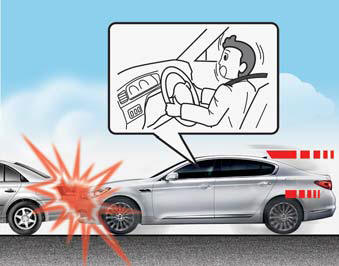
Front air bags
Front air bags are designed to inflate in a frontal collision depending on the intensity, speed or angles of impact of the front collision.
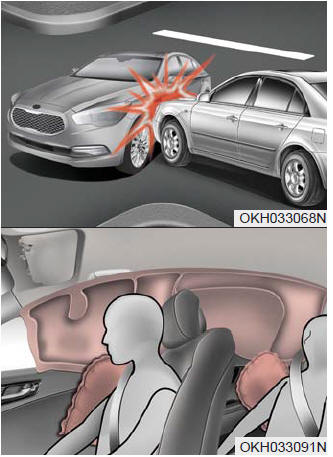
Side air bags
Side air bags (side and/or curtain air bags) are designed to inflate when an impact is detected by side collision sensors depending on the strength, speed or angles of impact resulting from a side impact collision.
Although the front air bags (driver’s and front passenger’s air bags) are designed to inflate in frontal collisions, they also may inflate in other types of collisions if the front impact sensors detect a sufficient frontal force in another type of impact.
Side impact and curtain air bags are designed to inflate in certain side impact collisions. They may inflate in other type of collisions where a side force is detected by the sensors.
If the vehicle chassis is impacted by bumps or objects on unimproved roads or sidewalks, air bags may deploy. Drive carefully on unimproved roads or on surfaces not designed for vehicle traffic to prevent unintended air bag deployment.
 Air bag collision sensors
(1) SRS control module
(2) Front impact sensor
(3) Side impact sensor (front)
(4) Side impact sensor (rear)
WARNING
Air bag sensors
Do not hit or allow any objects to impact the locatio ...
 Air bag non-inflation conditions
In certain low-speed collisions the air bags may not deploy. The air bags are
designed not to deploy in such cases because they may not provide benefits beyond
the protection of the seat belts i ...
See also:
Automatic transmission operation
The automatic transmission has 8 forward speeds and one reverse speed. The individual
speeds are selected automatically, depending on the position of the shift lever.
✽ NOTICE
The first few ...
Vehicle weight
This section will guide you in the proper loading of your vehicle and/or trailer,
to keep your loaded vehicle weight within its design rating capability, with or
without a trailer.
Properly loadi ...
Side repeater light bulb replacement
If the light bulb is not operating, have the vehicle checked by an authorized
K900 Kia dealer. ...
Categories
